

Artificial intelligence has rapidly transitioned from a futuristic novelty into an essential operational layer for modern society, yet a silent constraint has long defined its adoption. Until recently, leveraging high-performance generative models required heavy cloud infrastructure, continuous high-speed internet connectivity, and substantial data bandwidth. For remote communities, rural regions, and bandwidth-constrained environments, this meant that advanced artificial intelligence remained largely out of reach. Recognizing this strategic bottleneck, the Government of India, through the Ministry of Electronics and Information Technology (MeitY) under the IndiaAI Mission, has introduced a paradigm-shifting suite of homegrown foundation models designed to secure the nation’s technological autonomy.
The release of these sovereign artificial intelligence models marks a monumental turning point, transitioning India from a consumer of imported foreign technology to a producer of cutting-edge foundational infrastructure. Developed by leading domestic research labs and deep-tech enterprises under the IndiaAI Innovation Centre pillar, these models are tailored specifically to address India’s linguistic diversity, data security parameters, and critical operational sectors. Rather than relying perpetually on foreign application programming interfaces and external servers, researchers, enterprises, and citizens now have access to robust domestic alternatives that operate securely within national borders.
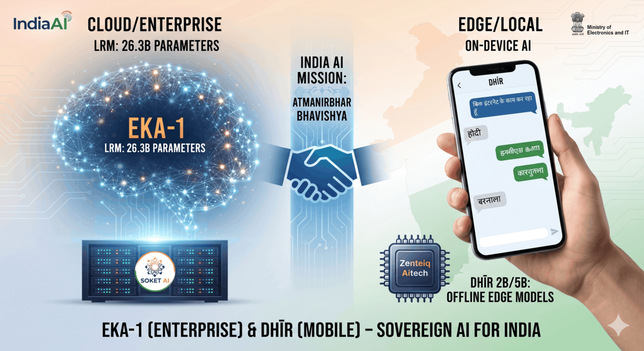
At the forefront of heavy reasoning and multi-domain processing is EKA-1, a massive open-source sparse hybrid language model developed by the Bengaluru-based deep-tech research company Soket AI (Soket Labs). Boasting an immense scale of 26.3 billion parameters and trained rigorously on roughly 7.5 trillion tokens, EKA-1 is engineered to handle complex cognitive workloads. Its architecture is built to support English alongside all 22 scheduled Indian languages, establishing a deeply inclusive digital framework. Unlike smaller conversational agents, EKA-1 is optimized for high-stakes, mission-critical environments such as banking compliance, financial auditing, cybersecurity threat triage, and scientific research. According to Soket AI’s leadership, including CEO Abhishek Boparwal, the model excels at advanced mathematical reasoning, rigorous code generation, and long-horizon logic, ensuring that automated systems can trace every calculation back to verifiable data points.
While EKA-1 anchors heavy enterprise workloads, the true democratization of everyday artificial intelligence is unlocked by Dhīr 2B and Dhīr 5B MoE, developed by the Bengaluru-born deep-tech company ZenteiQ Aitech Innovations (originating from IISc Bangalore). These compact, highly efficient foundation models were pretrained completely from scratch using Google Cloud Tensor Processing Units (TPUs) stationed in Mumbai. Dhīr 2B utilizes a dense transformer architecture with approximately 2.03 billion parameters, while Dhīr 5B employs a Mixture of Experts (MoE) design featuring around 5.09 billion total parameters with 1.79 billion active parameters per token.
The defining technical triumph of the Dhīr series is its featherlight architecture, which enables full on-device execution directly on local hardware without requiring any internet connection or cloud server access. Powered by optimized inference runtimes, these models can run smoothly offline on local devices, laptops with integrated graphics, edge hardware, and mobile phones. By eliminating cloud dependency, Dhīr models ensure absolute data privacy, allowing users to process sensitive documents and query local databases entirely offline while drastically conserving mobile data and battery life. Professor Shashi Kumar, CEO of ZenteiQ, emphasizes that these models support English alongside ten major Indian languages—including Hindi, Bengali, Telugu, Marathi, Tamil, Gujarati, Kannada, Malayalam, Punjabi, and Odia—making localized automation viable even in remote rural sectors where connectivity is intermittent.
Making these powerful sovereign tools accessible to the public is streamlined through the centralized AIKosh platform, established by the government to serve researchers, students, startups, and public sector institutions. By centralizing access to EKA-1 and the Dhīr family, the ecosystem empowers domestic developers to build specialized applications without facing prohibitive infrastructure barriers. Ultimately, India’s indigenous AI rollout proves that cutting-edge technology can be engineered locally to serve sovereign priorities, establishing a powerful benchmark for nations seeking true digital independence in the artificial intelligence era.